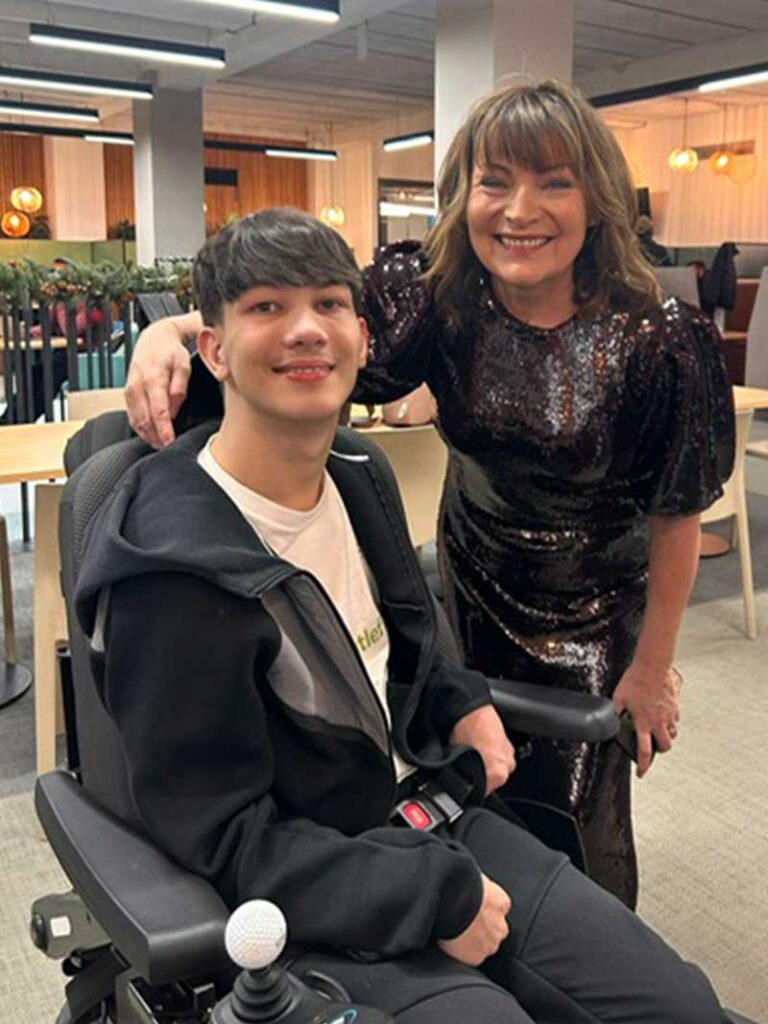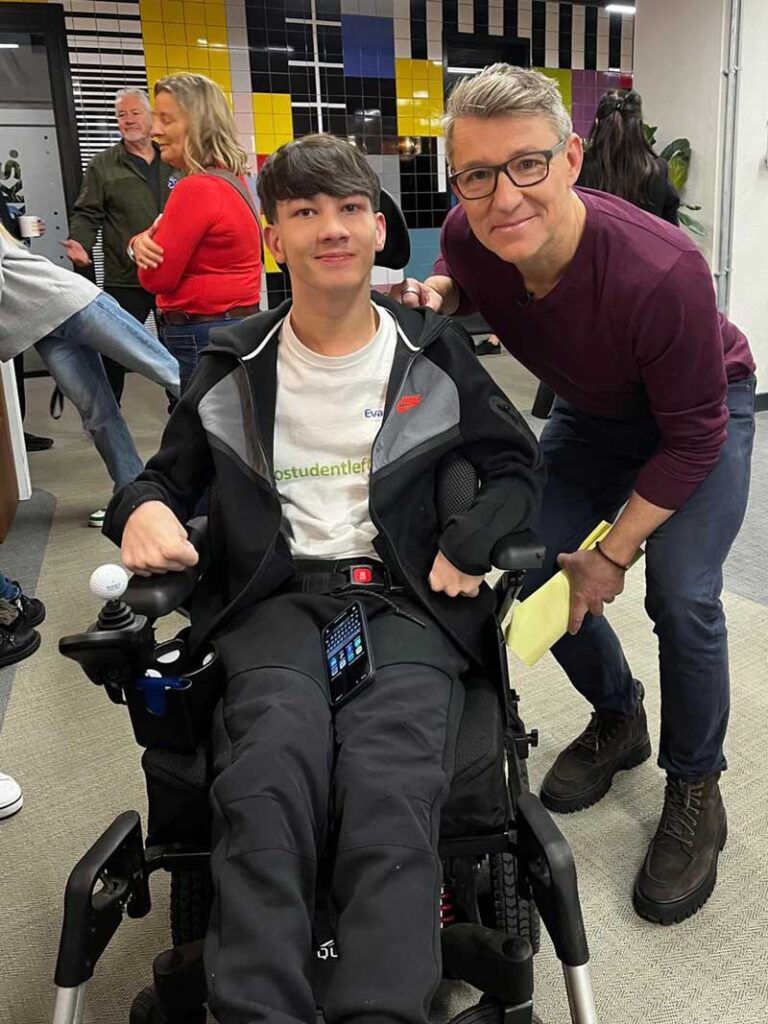
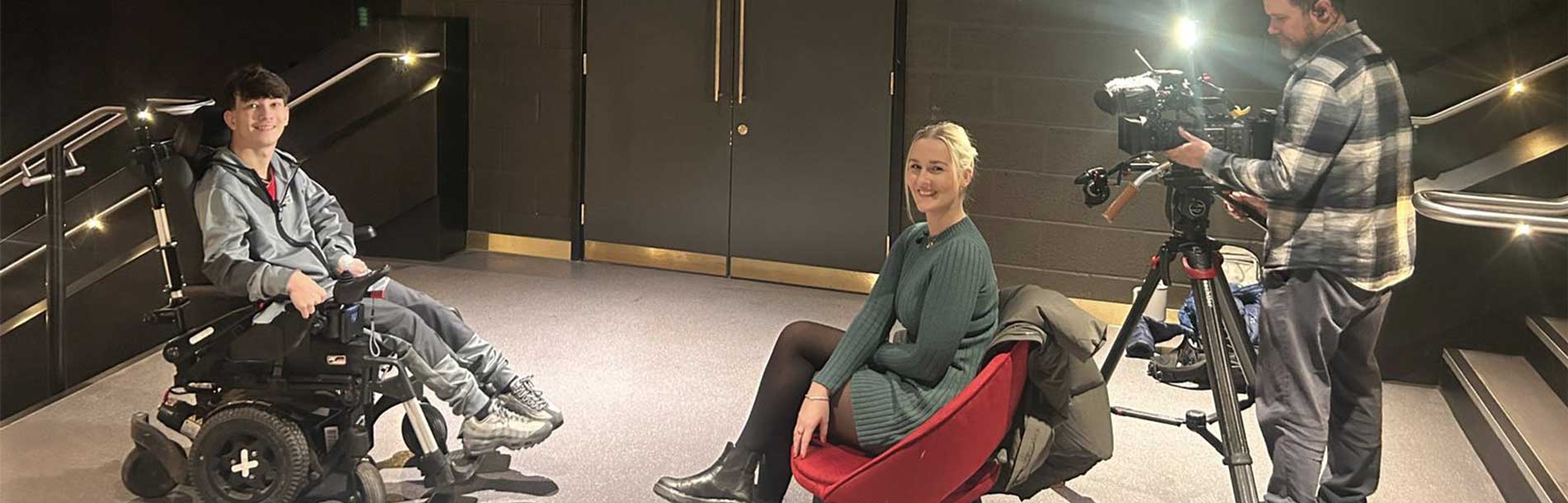
no student left behind campaign, Lucas Vezza-O'Brien

#NoStudentLeftBehind Campaign: Fighting for Equal Evacuation Safety in UK Schools

When 16-year-old Lucas Vezza-O’Brien smelled smoke filling the corridor of his school during a fire in November 2024, he experienced something no student should ever face: being told to wait alone whilst everyone else escaped to safety.

Lucas, who has cerebral palsy and uses a wheelchair, wasn’t left behind because staff didn’t care. He was left behind because Hyde High School, like thousands of schools across the UK, lacked the basic evacuation equipment needed to help wheelchair users evacuate multi-storey buildings safely during emergencies.
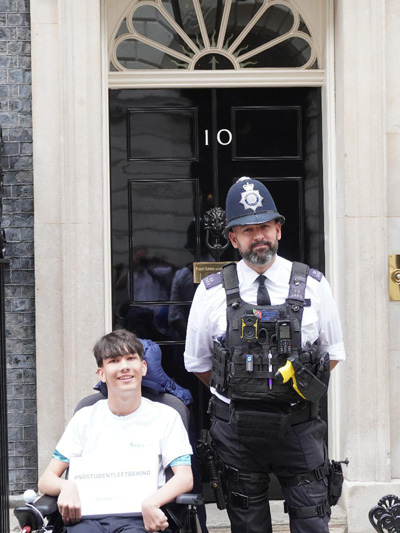
lucas outside 10 downing streetThe Incident That Sparked a Movement

The electrical fire at Hyde High School in Tameside, Greater Manchester, was ultimately minor and quickly brought under control by firefighters. But for Lucas, waiting on the first floor while smoke drifted through the building was a terrifying experience that exposed a shocking gap in school safety provisions.

“I was petrified,” Lucas recalled. “I started to smell smoke and because of my disability, I was worried about my immune system. If I got smoke into my lungs, who knows what would happen?”

From Frightened Student to National Campaigner

Rather than accept this frightening experience as unavoidable, Lucas decided to take action. His research revealed a disturbing truth: whilst most secondary schools in some areas like Tameside have evacuation chairs, there is no legal requirement for any school in England to provide this life-saving equipment.

“After it happened, I researched the current legislation and I was shocked to see that schools don’t have evacuation chairs,” Lucas explained. “They might be costly but you can’t put a price on my life, or other people’s.”

This discovery fuelled his determination to ensure no other disabled student would face the same fear and vulnerability. Lucas launched the #NoStudentLeftBehind campaign, calling for UK law to mandate that all schools and colleges provide evacuation chairs and proper staff training in their use.

The Campaign’s Growing Impact

Lucas’s petition to Parliament gained significant momentum, quickly surpassing 100,000 signatures and prompting a Parliamentary debate. The campaign attracted widespread media attention, with Lucas appearing on ITV’s Good Morning Britain and BBC North West Tonight to share his story and advocate for change.

“The reaction to the campaign has been amazing,” Lucas said. “Together, we can make a difference.”

Hyde High School’s headteacher praised Lucas in a letter to parents, describing him as “an extremely confident, funny, and determined young man” whose advocacy has “sparked national media attention.” The school has since received donated evacuation chairs and comprehensive staff training from industry specialists, ensuring all students can now be evacuated safely.

On 1 December 2025, MPs from across the political spectrum came together in UK Parliament to debate evacuation chairs for schools and colleges, following a petition signed by more than 100,000 people. The debate, held in Westminster Hall, focused on the safety of disabled pupils during emergency evacuations and highlighted growing concern that current guidance — including the use of Personal Emergency Evacuation Plans (PEEPs) — is not working in practice.

Opening the debate, Jacob Collier (Labour) paid tribute to the petition’s founder, Lucas Vezza-O’Brien, saying:

“Every child deserves a safe and dignified exit from a building during a fire alarm or real fire, and that disabled pupils must not face greater danger than their friends.”

He added: “Lucas has shown incredible courage in reliving a horrifying experience so that other children will not go through the same ordeal.”

A recurring theme throughout the debate was the need for PEEPs to be mandatory, rather than optional or inconsistently applied. Munira Wilson (Liberal Democrat) highlighted that relying on informal arrangements or goodwill leaves disabled pupils exposed, telling MPs that “current guidance for the evacuation of disabled pupils is simply not sufficient” and that proper evacuation planning must be consistently required, not left to individual schools to interpret.

This view was echoed across parties. Dr Neil Shastri-Hurst (Conservative) questioned whether existing policy reflects modern expectations, asking whether current guidance “does not recognise that the technology has moved on”, particularly when effective evacuation equipment already exists. Jim Shannon (DUP) was clear that plans without practical means of escape are ineffective, stating:

“The provision of evacuation chairs is imperative — all schools and colleges, across the whole of the United Kingdom, must have them for pupils, staff and visitors.”

He also stressed that PEEPs must be properly supported by training so that they work during real emergencies, not just on paper.

The debate also included positive recognition of the Emergency Group and its role in supporting the campaign. Saqib Bhatti (Conservative) told MPs:

“He is joined by his mum, and by Nick from the Emergency Group, who has been supporting Lucas in his campaign and donated evacuation chairs to Lucas’s school.”

He added: “The Emergency Group has since made him an ambassador — a very wise decision.”

Responding for the Government, Georgia Gould (Labour) acknowledged the strength of feeling behind the petition and the impact of the campaign, recognising that evacuation planning — including mandatory PEEPs backed by the right equipment and training — is central to ensuring disabled pupils can leave buildings safely and with dignity. She also agreed to meet with the campaign to discuss the issues raised in the debate and the next steps for improving evacuation safety in schools and colleges.

Taken together, the debate offered clear cross-party consensus: evacuation safety cannot rely on informal arrangements or written plans alone. MPs repeatedly made the case that PEEPs should be mandatory and properly resourced, so disabled pupils are never left waiting, isolated or unsafe during an emergency.

Links for the Debate Transcript, News Articles & TV Appearances

All links below open in a new browser window:

lucas-with-lorraine-kelly
lucas with ben shepherd
lucas-witj-david-walliams

Why This Matters: The Equality Question

The #NoStudentLeftBehind campaign raises fundamental questions about equality in emergency preparedness. Schools invest in fire alarms, extinguishers, clearly marked exits and regular fire drills for able-bodied students. If these safety measures are considered essential, why shouldn’t evacuation equipment for disabled students receive the same priority?

Current UK legislation, including the Regulatory Reform (Fire Safety) Order 2005 and the Equality Act 2010, requires schools to consider the needs of disabled people in their fire risk assessments and make reasonable adjustments. However, the lack of specific legal requirements for evacuation equipment means many schools rely on the “stay put and wait for rescue” approach‚Äîa strategy that leaves disabled students uniquely vulnerable during emergencies.

A Voice for Change

Since launching his campaign, Lucas has demonstrated remarkable leadership and communication skills. His work has earned him recognition as a Campaign Ambassador, where he collaborates with emergency response professionals to push for policy reform in school safety standards.

Lucas emphasises that his campaign extends far beyond his personal experience: “This isn’t just about what happened to me. It’s about making sure every disabled student in every school knows they won’t be abandoned in an emergency. We deserve the same safety as everyone else.”

The Broader Picture

The #NoStudentLeftBehind campaign highlights inconsistencies across the UK education sector. Whilst some local authorities have proactively equipped schools with evacuation chairs, many institutions lack this essential safety equipment. This creates a postcode lottery where a disabled student’s safety during a fire depends on which school they attend‚Äîan unacceptable disparity in a matter of life and death.

Evacuation chairs are designed to allow a single trained operator to safely transport wheelchair users down staircases during emergencies. They provide a practical, cost-effective solution that enables schools to evacuate all students quickly without relying on emergency services arrival times or hoping fires remain contained.

What Are Evacuation Chairs?

Evacuation chairs are specially designed emergency devices that enable the safe transport of people with mobility impairments down staircases during building evacuations. These chairs can be operated by a single trained person and are specifically engineered to navigate stairwells safely and efficiently.

Key features of evacuation chairs include:

  • Track System: Designed to smoothly glide down stairs whilst the operator maintains control
  • Restraint Straps: Secure harnesses to keep the person safely in the chair during descent
  • Compact Storage: Can be wall-mounted or stored in emergency equipment cabinets
  • Minimal Training Required: Staff can be trained to operate them confidently in just a few hours
  • Cost-Effective: Significantly more affordable than installing evacuation lifts or other permanent solutions

These devices are already widely used in workplaces, hospitals, and some educational institutions. The #NoStudentLeftBehind campaign advocates for their mandatory presence in all schools and colleges.

Current Legal Requirements for Schools

Under the Regulatory Reform (Fire Safety) Order 2005, schools must conduct fire risk assessments that account for all building occupants, including those with disabilities. The Equality Act 2010 requires schools to make reasonable adjustments to ensure disabled students are not disadvantaged.

However, critically, PEEPs are not mandated by law. Current guidance states that schools should have PEEPs in place, rather than must—a significant legislative gap that allows schools to avoid concrete planning. Furthermore, neither piece of legislation explicitly requires schools to provide evacuation chairs or similar equipment. This legal ambiguity, combined with the discretionary nature of PEEPs, means schools can technically comply with regulations by implementing a “stay put and wait for rescue” strategy—precisely the approach that left Lucas waiting during the November 2024 fire, with no formal PEEP documenting how he would be evacuated safely.

The #NoStudentLeftBehind campaign seeks to close this legal loophole by making evacuation equipment and staff training mandatory requirements for all educational institutions with multi-storey buildings.

The Cost Argument

Some schools cite budget constraints as a barrier to purchasing evacuation equipment. However, when examined against the potential consequences of leaving disabled students vulnerable during fires, the cost argument weakens considerably.

Evacuation chairs typically cost between £500-£2,000 per unit depending on the model and features. For a typical secondary school with multiple floors, an investment of £3,000-£6,000 could provide comprehensive coverage. Training costs are minimal, often provided free or at low cost by equipment suppliers.

Compare this to the potential liability costs, reputational damage, and‚Äîmost importantly‚Äîthe risk to students’ lives, and the investment becomes not just reasonable but essential.

As Lucas powerfully stated: “They might be costly but you can’t put a price on my life, or other people’s.”

What Schools Can Do Now

Schools don’t need to wait for legislation to change before taking action. Forward-thinking institutions across the UK are already implementing evacuation equipment and training programmes.

Immediate steps schools can take:

  • Conduct a thorough audit of current evacuation capabilities for students with mobility impairments
  • Research evacuation equipment options suitable for your building layout and student needs
  • Budget allocation for evacuation chairs in the next financial year
  • Staff training programmes to ensure multiple staff members can operate equipment confidently
  • Review and update PEEPs (Personal Emergency Evacuation Plans) for affected students
  • Regular drills that include evacuation chair deployment to ensure procedures work effectively
  • Communication with parents about evacuation provisions for students with additional needs

Many equipment suppliers offer free demonstrations, allowing schools to evaluate different models before purchasing. Some also provide grant guidance or payment plans to assist with budget constraints.

Impact Beyond Schools

Whilst Lucas’s campaign focuses on educational settings, the principles extend to all buildings where young people gather. Youth clubs, sports facilities, community centres, and other venues serving young people with disabilities should similarly assess their evacuation capabilities.

The campaign has sparked conversations about emergency preparedness across multiple sectors, prompting organisations to reconsider how they protect their most vulnerable members during crises.

How You Can Support

Lucas is calling on parents, teachers, school administrators, local authorities and the general public to support his campaign for mandatory evacuation equipment in all UK educational settings.

Ways to Take Action:

Sign the Parliamentary Petition: Lucas’s petition needs 10,000 signatures to receive an official government response. Every signature brings the campaign closer to achieving meaningful legislative change.

Raise Awareness: Share the #NoStudentLeftBehind campaign on social media platforms to help spread Lucas’s message to a wider audience.

Contact Your School: Ask your child’s school about their emergency evacuation provisions for students with mobility impairments. Enquire whether evacuation chairs are available and whether staff have received appropriate training.

Write to Your MP: Contact your local Member of Parliament to express support for mandatory evacuation equipment in schools and colleges.

Engage Local Authorities: Encourage your local education authority to audit schools in your area and provide evacuation equipment where gaps exist.

Lucas’s Message

“We’re not asking for special treatment,” Lucas emphasises. “We’re asking for equal treatment. When there’s a fire, every student should have the same chance to get out safely. That’s not too much to ask.”

His campaign serves as a powerful reminder that disability access isn’t simply about ramps, lifts and wider doorways during normal school operations. True accessibility means ensuring every student can escape danger when seconds count‚Äîregardless of their physical abilities.

The Campaign Continues

As Lucas continues gathering support for his parliamentary petition, his story has resonated with parents, educators and disability rights advocates across the country. The campaign has opened important discussions about emergency preparedness in educational settings and the responsibilities schools hold towards their most vulnerable students.

The #NoStudentLeftBehind campaign asks a simple but crucial question: if we believe all students have the right to education, don’t they also have the right to escape their school safely during an emergency?

For Lucas Vezza-O’Brien, the answer is clear‚Äîand he won’t stop campaigning until the law agrees.

Join the Movement

The #NoStudentLeftBehind campaign represents more than one teenager’s response to a frightening experience. It embodies a fundamental principle: every student deserves equal protection during emergencies, regardless of their physical abilities.

By supporting Lucas’s campaign, you’re advocating for sensible, achievable safety measures that could prevent future tragedies. You’re standing up for the rights of disabled students to feel safe in their schools. And you’re sending a clear message that the safety of all students matters.

The #NoStudentLeftBehind campaign is gathering signatures for a parliamentary petition calling for mandatory evacuation chairs and training in all UK schools and colleges. To support this vital cause and help ensure no student is ever left behind during an emergency, search for the campaign online or contact your local representatives to express your support for this important safety initiative.